"If I could do absolutely anything I wanted to do, the only thing I would rather do than what I am doing is to terra-form other planets," I once told a friend.
Terra-forming is the process of transforming a lifeless planet like Mars or Venus into livable habitat - kind of like gardening on a major scale. But realistically (for better or worse), we are terra-forming our own planet - building roads and cities, carving up mountains, building dams, and rewriting ecosystems in many ways large and small.
Indeed, who can resist doing a bit of terra-forming in the yard, building or leveling little hills, excavating ponds, or planting trees and gardens? In the selection of books below you will find all kinds of creative ideas to guide sensible terra-forming projects in your yard.
Water is such a precious resource, and probably the most valuable commodity in the arid west, yet oddly, desert environments have the most signs to warn about possible flooding. When it rains, the water is channeled off houses into storm drains, and off the landscape into gully washers. But you can turn water scarcity into water abundance by capturing and using rainwater at home.
Rainwater Harvesting for Drylands, Volume 1 is the core of a three-volume guide (under development) on how to conceptualize, design, and implement sustainable water-harvesting systems for your home, landscape, and community. This book enables you to access your on-site resources (rainwater, greywater, topsoil, sun, plants, and more), gives you a diverse array of strategies to maximize their potential, and empowers you with guiding principles to create an integrated, multi-functional, and water-sustainable water-harvesting landscape plan specific to your site and needs. The book is primarily about catching rainwater for use outside your home for watering the garden and landscape.
Rainwater Harvesting for Drylands includes enough stories, illustrations and simple ideas to inspire and educate readers of all capabilities. With creativity, humor, and common sense, Lancaster shows the reader how to put rainwater to use growing food, shading your home, reducing erosion, and improving wildlife habitat. In addition to conserving money and resources while enriching your surroundings, you can create a landscape that is more beautiful and less work and upkeep than you might imagine.
Lancaster's rainwater research was inspired by a Mr. Phirri in Africa, a man who was arrested several times for "stealing water" from his neighbors during the dry season. He grew and harvested vegetables even when no one else could, and his well never ran dry. But he wasn't stealing water, which he had to prove to the judge by showing off his innovative use of rainwater. He became known as "The man who farms water."
Brad Lancaster and his brother learned from Mr. Phirri's work and implemented the techniques in Arizona to see if it worked there. Their experiences helped influence the city of Tucson to adopt new practices to save precious water for its citizens.
Techniques that work in the extreme environment of Tucson may be applied anywhere. The book includes much more than merely putting out barrels to collect rainwater. You will learn to rethink your entire landscape and grading, creating a microenvironment that will nurture itself. Lancaster's common sense is so extraordinary that you may find yourself wondering why you didn't think of it yourself!
Lancaster has a friendly, conversational writing style that makes the book a pleasure to read. The design principles are inspiring and simple to follow, with enough technical information that you won't be left wondering how to proceed. Rainwater is also much better for plants than either city water or well water, which tends to have a high mineral content. Even high-rainfall areas have dry seasons and droughts, and the methods presented in this book will help your landscape thrive with less input from you. Clearly written with more than 40 photos and 115 illustrations. Rainsource Press. 2006. 183 pages. Printed on 50% post-consumer recycled paper.
Authorized affiliate of Bookshop.org and Amazon.com.
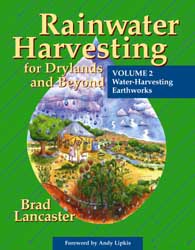
Rainwater Harvesting for Drylands and Beyond, Volume 2 is a how-to guide for creating water-harvesting "earthworks." Earthworks are simple, inexpensive strategies and landforms that passively harvest free rainfall, runoff, air conditioning condensate, and greywater within the soil. Integrated vegetation then pumps the water back out in the form of beauty, food, shelter, wildlife habitat, timber, and passive heating and cooling, while controlling erosion, increasing soil fertility, reducing downstream flooding, dropping utility costs, and improving water and air quality.
Building on the information in Volume 1, this volume shows you how to turn your yard, local school, or neighborhood into a lively, regenerative producer of resources. Conditions at home will improve as you simultaneously enrich the ecosystem and inspire the surrounding community.
Learn to select, place, size, construct, and plant your chosen earthworks. Detailed step-by-step instructions with over 460 illustrations and photos show you how to do it, and plentiful stories of success motivate you so you will do it! Rainsource Press. 2008. 418 pages. Printed on 100% post-consumer recycled paper.
Authorized affiliate of Bookshop.org and Amazon.com.
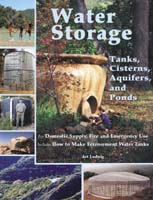
Water Storage Tanks, Cisterns, Aquifers, and Ponds For Domestic Supply, Fire and Emergency Use Includes How to Make Ferrocement Water Tanks by Art Ludwig of Oasis Design
Water Storage describes how to store water for home, farm, and small communities. It will help you design storage for just about any use, including fire safety and emergency, in just about any context--urban, rural, or village. The book includes:
general principles to help you design, construct, and use any water system
a look at common mistakes and how to avoid them
how the different kinds of storage can serve you--tanks, groundwater, and ponds
how to determine the optimum amount of storage for your needs
how to determine the best shape and material for your storage
how to manage aquifers sustainably for inexpensive storage of water in the ground
plumbing details for inlets, outlets, drains, overflows, access, etc.
storage accessories and gadgets such as automatic shut-off valves, remote level indicators, ozonators, and filters
how to build your own high-quality tank from ferrocement
original design innovations--published for the first time--to improve the quality of stored water, increase water security, make maintenance easier, and reduce environmental impacts
real-life examples of storage designs for a wide range of contexts
This book offers underlying design principles as well as design specifics. If you run into a situation not specifically covered, there's a good chance you'll be able to use these general principles to figure it out yourself. Installed water storage typically costs fifty cents to three dollars or more per gallon. If you've got this book in your hands, then you are probably on the verge of making decisions about hundreds or thousands of dollars worth of storage. On an average water system, this book could pay for itself a hundred times over in savings on construction and maintenance.
Authorized affiliate of Bookshop.org and Amazon.com.
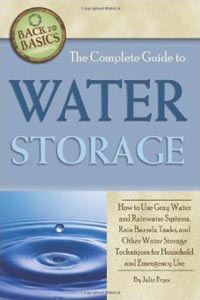
The Complete Guide to Water Storage How to Use Gray Water and Rainwater Systems, Rain Barrels, Tanks, and Other Water Storage Techniques for Household and Emergency Use by Julie Fryer
Water is the most important natural resource in your life you use it to drink, to water your lawn, to clean yourself, your dishes, and your clothes, and to cook. Nothing can be done in life without water, and yet if an emergency occurs, the Federal Emergency Management Agency estimates that nearly 4 in 5 Americans would be without access to clean water if a major disaster disrupted or contaminated their public water supply. It is for this reason that many individuals have looked into the possibility of utilizing tanks, ponds, and other means of water storage to maintain a safe, viable source of drinking water for them and their families in the case of an emergency.
This book will guide you through the process of learning more about these potential lifesaving water storage methods, the legal implications, and the financial aspects of storing your own water for future. There are numerous ways you can store water for emergency or future use; this book will help you learn everything you need to start taking advantage of those methods according to the space you have and the time and money you can invest. You will learn all of the basic design principles of water storage as well as how water quality is measured and maintained while in storage. You will learn the various ways to store water, from soil to direct to aquifers, ponds, open tanks, swimming pools, and tanks. You will learn the various types of water tank design for each method of storage and what each one involves and requires.
Water purification and construction experts have been interviewed for this book and their insights have been added to provide you with every possible outlook and detail you might need to effectively store your water. You will learn the necessary aspects of tank roofs, the costs, footings, floorings, designs, and most importantly your local regulations regarding storage of water on your property. You will learn about the hazards involved in water storage and how to deal with inlets, outlets, service access, drains, bugs, and rodents. You will learn about the necessary optional features for safety and quality and how much water you need for emergency storage in different situations. For every possible water storage solution you might be considering, this book will cover every aspect. 288 pages. Back to Basics Conserving Series. Atlantic Publishing Group Inc. 2011. ISBN: 978-1601383631.
Authorized affiliate of Bookshop.org and Amazon.com.


 DirtCheapBuilder.com