Thomas J. Elpel's
Web World Portal


DirtCheapBuilder.com


Share on Facebook!

DirtCheapBuilder.com
Build Your Own Low-Cost, Earth-Friendly, High-Efficiency Home!
Home | House Building | Tom's Books & Videos | Articles | Building Schools
Helpful Links | E-Mail | Search this Site

Terra Tiles
Low-cost, do-it-yourself soil-cement tiles!

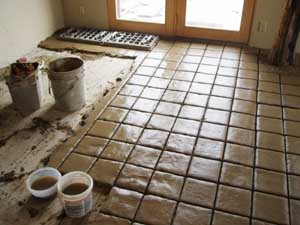
      Terra tiles are inexpensive floor tiles made from a mix of dirt, sand, and cement. Terra tiles were developed out of "rammed-earth" technology, where a soil-cement mix is poured into wall forms and tamped or compacted with hand or power tools to make very dense, strong walls. Terra tile mix is similar, but it is simply troweled into place without being compacted, and the tiles are cut with an over-size "cookie cutter." The idea was pioneered in California in the late 1970's, by David Easton, a rammed-earth contractor.

      Through trial-and-error Easton developed a basic process for making terratiles, including some of what not to do-like trying to mix the very sticky mortar in a concrete truck, or trying to tamp it like the drier material used in rammed-earth walls. We learned about terratiles through articles by Easton (Popular Science, 1988) and by an associate of his, Magnus Berglund (Fine Homebuilding, 1985). There is also a chapter on terra tiles in his book The Rammed Earth House.

      In the course of tiling four homes, we have learned more about what not-to-do, as well as more of what really works to make truly beautiful, and very low-cost tile floors. Tom included the latest information on terra tiles in his book Living Homes: Stone Masonry, Log, and Strawbale Construction. Note: The plastic brickforms we used to stamp out our tile floors are no longer available. We are seeking new alternatives.


Go to
Living Homes: Stone Masonry, Log, and Strawbale Construction

Hi Tom,

      Here are pictures of our project. The dirt we used was red, and our end result was sort of a chocolate brown. I included pictures of where we got the dirt, Brian preparing the underlayment, which consisted of plastic with the radient floor tubes on top. Our floor ended up too thick, as I was using the wrong end of a wood block to measure it, but it seems fine, and I love the way it feels underneath my feet. We are experiencing some cracking of the grout in the high traffic area, but I think thats because the floor flexes there more, so we're planning on reinforcing from underneath before I fix it. Thanks again for the use of the forms. By the way, It took two days to form the floor.

Thanks,

Pat Scott


See also: Living Homes: Stone Masonry, Log, and Strawbale Construction.

Return to DirtCheapBuilder.com Home
Return to the Sustainable Living Page
Return to Thomas J. Elpel's Web World Portal

Books
authored by
Thomas J. Elpel

Roadmap
to Reality

Direct
Pointing

Living
Homes

Participating
in Nature

Botany
in a Day

Shanleya's
Quest


Return to Thomas J. Elpel's
Web World Portal | Web World Tunnel

Thomas J. Elpel's Web World Pages
About Tom | Green University®, LLC
HOPS Press, LLC | Dirt Cheap Builder Books
Primitive Living Skills | Sustainable Living Skills
Wildflowers & Weeds | Jefferson River Canoe Trail
Roadmap To Reality | What's New?

© 1997 - 2012 Thomas J. Elpel